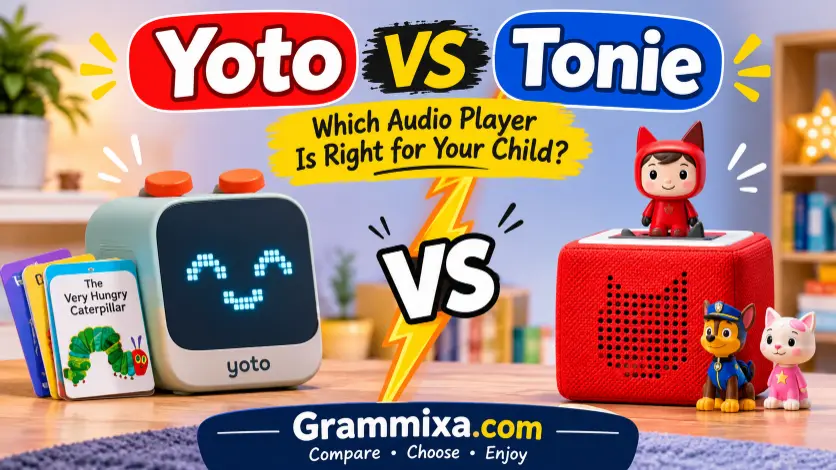
Choosing between Yoto vs Tonie can feel tricky when both promise to make storytime more fun without relying on screens. These popular audio players let children enjoy stories, music, and other audio content, but they work in different ways. Yoto uses physical cards that children insert into the player, while Toniebox uses character figures that children place on top to start listening. Both offer a playful way to encourage independent listening, imagination, and quiet time.
So, which one is better for your family? That depends on your child’s age, listening habits, favourite stories, and how much flexibility you want. Yoto may appeal to families who prefer a card based system with a range of audio options, while Tonie may be more exciting for little ones who love colourful characters and hands on play.
In this guide, we’ll compare Yoto vs Tonie across the features that matter most to parents, including ease of use, durability, available content, and overall value. By the end, you’ll have a clearer idea of which audio player suits your child’s needs, your budget, and your family’s daily routine.
Yoto vs Tonie comes down to how your child prefers to choose and enjoy audio. Yoto uses physical cards and offers a digital display, a programmable night light, and flexible custom audio options. Toniebox uses collectible character figures and simple touch controls, with Tonieplay games available on Toniebox 2. Both offer screen-free listening and offline playback after content downloads.
Yoto vs Tonie: What Is the Difference?
Yoto and Toniebox are screen-free audio systems designed to let children enjoy stories, music, and other audio content without needing a phone or tablet. The main difference is how children select their listening material and interact with the device.
With Yoto, children insert a physical card into the player. With Toniebox, they place a character figure, called a Tonie, on top of the box. Both systems also offer ways to personalize audio, although their methods differ.
Quick Comparison
| Feature | Yoto Player | Toniebox 2 |
|---|---|---|
| Audio selection | Physical cards and supported digital playlists | Character figures called Tonies |
| Visual display | Pixel display for information and clock functions | Dynamic light ring |
| Custom audio | Make Your Own cards and app features | Creative Tonies |
| Bedtime features | Night light, clock, and wake-up settings | Sleep timer with light and sunrise alarm |
| Interactive games | Primarily an audio experience | Tonieplay games with compatible accessories |
| Offline playback | Yes, for downloaded content | Yes, for downloaded content |
| Listening controls | Physical buttons and card insertion | Touch-sensitive ears, sides, and top |
| Best suited to | Families wanting flexible audio choices | Families who enjoy character-based play |
These features refer to the current Yoto Player generation and Toniebox 2. Older models differ, and accessories or additional purchases may be required for some features.
How Each System Works
Yoto uses cards to identify audio content. Insert a card to start playback, then use the physical controls to adjust the volume or navigate content. The current Yoto Player also supports selected playlists through its Green Button feature.
Toniebox uses a more tactile approach. Place a compatible Tonie figure on the box to start its associated stories or songs. Children can control playback through physical gestures, making the system easy to explore without navigating a traditional screen.
Neither approach is universally better. The right choice depends on whether your child enjoys choosing from cards or interacting with familiar characters.
Which Is Better for Different Ages?
Age is an important consideration, but individual development, interests, and listening habits matter just as much.
For Toddlers
Toniebox 2 is officially designed for children aged 1 and older. Its character-based controls may appeal to toddlers who enjoy handling objects and connecting familiar characters with favorite songs or stories.
Yoto can also suit younger children when an adult helps select cards and manage the player. Its cards offer a straightforward way to introduce stories, nursery rhymes, and calming audio.
For very young listeners, prioritize supervision, comfortable listening volume, and age-appropriate content rather than choosing solely by advertised age range.
For Preschoolers
Both systems can support independent listening as children learn to make choices and operate simple controls.
Yoto may appeal to preschoolers who enjoy selecting different cards and exploring audio independently. Toniebox may appeal to children who prefer recognizable characters and physical play.
Consider how your child already plays with toys. A child who enjoys collecting figures may connect naturally with Tonies, while a child who likes sorting and selecting cards may prefer Yoto.
For School-Age Children
Older children may benefit from a wider variety of stories, longer audiobooks, music, and educational content.
Yoto offers a card-based library that can grow with a child’s changing interests. Tonies offers character-based audio, audiobook figures, and, on Toniebox 2, access to Tonieplay interactive games with the required accessories.
Check the available content in your region before buying. Titles, languages, and product availability can vary.
Content Libraries and Creative Options
A player is only as useful as the content your child wants to hear. Compare the available stories, music, audiobooks, and language options before deciding.
Yoto Cards and Make Your Own
Yoto uses physical cards for individual audio titles and supports Make Your Own cards for personal audio collections. Depending on the content and setup, families can use their own recordings and other supported audio to create a more personalized listening experience.
This can be useful for families who want to record a relative reading a bedtime story, share a personal message, or organize selected audio into a physical collection.
The current Yoto Player also offers free audio content through Yoto’s app and platform, including selected stories, radio, podcasts, and sleep sounds. Some streaming content requires an internet connection.
Tonies and Creative Tonies
Toniebox uses collectible figures that represent specific audio content. The collection includes stories, songs, audiobooks, and other child-focused material.
Creative Tonies let families add supported personal recordings or audio from the tonies content library. This makes it possible to create a more personal listening experience without using a Yoto-style card.
The important distinction is physical format: Tonies remain figures that sit on the player, while Yoto’s primary physical format is the card.
Which Has Better Content?
Neither platform has a universal advantage for every child.
Choose Yoto if its available cards, audiobook selection, custom audio options, and supported digital features match your family’s interests.
Choose Toniebox if your child is more interested in collectible characters or you prefer selecting audio through physical figures.
Before purchasing, search both official stores for your child’s favorite characters, books, music, and languages. A smaller collection of content your child loves can be more valuable than a larger library they rarely use.
Bedtime Features and Daily Routines
Both systems can be useful beyond daytime listening, but their specific bedtime features differ by generation.
Yoto for Sleep and Wake-Up Routines
The current Yoto Player includes a night light, clock, and configurable okay-to-wake functions. It also provides access to sleep sounds and other calming audio.
These features can help families create a consistent bedtime routine and give children a visual cue for when it is time to get up. Yoto’s display and light-based features may be especially appealing to parents who want an audio player that also supports morning and evening routines.
Toniebox for Bedtime
Toniebox 2 includes a sleep timer with light and a sunrise alarm. Its bedtime functions can be configured through the tonies app.
The sunrise alarm and light can make the player useful as part of a morning routine as well as an evening listening habit. However, these newer features should not be assumed to exist on the original Toniebox.
Which Is Better for Bedtime?
Yoto is a strong option if you prefer its display, clock, and night-light combination.
Toniebox 2 is worth considering if your child already enjoys Tonie figures and you want dedicated bedtime and wake-up functions within the same system.
For either device, check the controls available on the exact model and configure appropriate volume and sleep settings.
Offline Listening and Travel
Both Yoto and Toniebox can play previously downloaded content without an active internet connection. The important detail is that new content may need to be downloaded before you travel.
Does Yoto Work Without Wi-Fi?
Yes. Yoto requires Wi-Fi during initial setup and when downloading content for playback. Once a card’s audio has finished downloading, the player can play that content offline.
However, radio stations, podcasts, and other content that streams continuously still require an internet connection. Families planning a flight, road trip, or camping trip should prepare the audio library in advance.
Does Toniebox Work Without Wi-Fi?
Yes. A Toniebox can play Tonies whose content has been fully downloaded to the device.
The first setup and downloading new content require a connection. Once a Tonie is downloaded, it can be used without Wi-Fi, provided the player has the required stored content.
The original Toniebox and Toniebox 2 have different controls and features, so follow the official instructions for your model when preparing it for offline use.
Which Is Better for Travel?
Both can work well for travel. The better option depends on what your child finds easiest to manage and which audio collection you already own.
Before leaving home:
- Connect the player to Wi-Fi.
- Download the content you plan to use.
- Confirm that the selected stories play offline.
- Charge the device and pack its required charging accessories.
- Remember that streaming services may not work without a connection.
Neither system eliminates the need to prepare downloaded content ahead of time.
Price, Accessories, and Long-Term Value
The initial price is only one part of the cost. Consider the player, included content, extra cards or figures, optional accessories, and how much your child is likely to use the system.
What Should You Budget For?
Yoto and Toniebox both use physical content products, but their formats differ.
For Yoto, you may buy additional cards or accessories and create personal cards using supported audio. Some audio features are available without buying individual physical cards.
For Toniebox, you may purchase extra Tonie figures, Creative Tonies, and compatible accessories. Tonieplay games require a compatible Toniebox 2 and the relevant controller or game products.
Prices vary by country, retailer, model, bundle, and promotion. As a result, comparing two starter bundles at their actual checkout prices is more useful than assuming either brand always costs less.
Which Offers Better Value?
Yoto may provide better value for families who appreciate customizable cards, a broad selection of audio, and its built-in clock and night-light features.
Toniebox may provide better value for families who enjoy collecting characters and want their child to choose stories through physical figures.
To compare total costs fairly, make a short list of the content your child wants, add the price of the player and necessary accessories, and estimate how many additional titles you may purchase during the next year.
The system that matches your family’s habits and budget is likely to provide the better long-term value.
FAQs:
Is Yoto better than Toniebox?
Neither is automatically better. Yoto suits families who prefer physical cards, custom audio options, and a display with clock and light functions. Toniebox suits children who enjoy character figures and simple, tactile controls. Compare the content and features of the exact models before buying.
Can Yoto and Toniebox play the same stories?
Not through their physical media. Yoto uses Yoto Cards, while Toniebox uses compatible Tonie figures. Check each platform’s library to see whether the same book, character, or story is available on both systems.
Which is easier for a toddler to use?
Toniebox 2 is designed for ages 1 and older, and its figure-based design can suit children who enjoy handling toys. Yoto may also work well with adult guidance. The easier option depends on the child’s motor skills, interests, and familiarity with the controls.
Do Yoto and Toniebox need Wi-Fi?
Both need Wi-Fi for setup and downloading new content. Previously downloaded audio can play offline. Content that requires continuous streaming, such as internet radio or some podcasts, still needs a connection.
Can parents add their own recordings?
Yes. Yoto supports Make Your Own cards, while Toniebox offers Creative Tonies. Both can support personalized audio, although the setup and physical formats differ.
Is Toniebox 2 compatible with older Tonies?
Yes. According to official tonies support documentation, existing Tonies work with Toniebox 2. Tonieplay games, however, are exclusive to Toniebox 2 and do not work on the original Toniebox.
Conclusion:
The choice between Yoto and Toniebox comes down to your child’s preferred way to listen, the content available in your region, and the features your family will actually use.
Choose Yoto if you prefer cards, customizable audio, a display, and integrated clock and night-light functions. Choose Toniebox 2 if your child enjoys collectible characters, hands-on controls, and the option of screen-free interactive games.
Before buying, compare the complete starter bundles, check favorite titles on both platforms, and confirm that the model includes the bedtime or playback features you want. That approach will help you choose a player your child can enjoy for years rather than one that looks appealing only on the shelf.
