
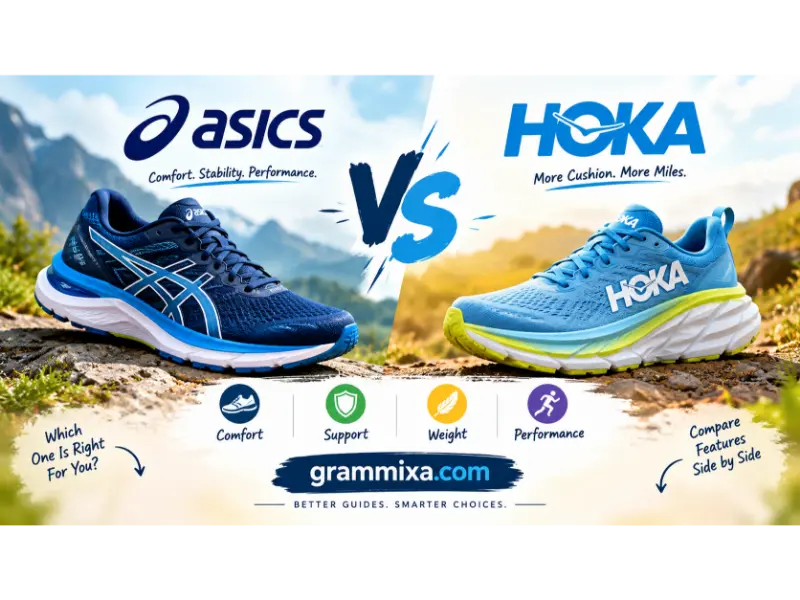
Choosing between ASICS and HOKA can feel like a race before you have even tied your laces. Both brands are popular among runners, walkers, and people who spend long hours on their feet, but they offer different experiences. So, which one deserves a place in your shoe rack?
ASICS is well known for its balanced cushioning, reliable stability, and running shoes designed for different foot types and training needs. HOKA, on the other hand, stands out for its thick midsoles, lightweight designs, and plush cushioning that many runners and walkers appreciate. While both brands offer comfortable options, the best choice depends on your feet, running style, and personal preferences.
In this ASICS vs HOKA comparison, we will explore cushioning, comfort, stability, durability, fit, and price to help you understand what sets these two popular brands apart. Whether you are training for your first 5K, preparing for a marathon, walking around town, or simply looking for everyday comfort, there are a few important differences worth knowing before you buy.
By the end, you will have a clearer idea of which brand suits your needs, budget, and lifestyle. After all, the best running shoe is not necessarily the one with the biggest sole or the most familiar logo. It is the one that feels right for you.
ASICS vs HOKA comes down to cushioning, fit, stability, and running preferences. ASICS offers a broad range of shoes, including models focused on support, responsiveness, and everyday training. HOKA is known for its cushioned designs, rocker-shaped soles, and smooth transitions. Both brands make road and trail running shoes, so the best choice depends on your feet, intended use, comfort, and preferred ride.
ASICS vs HOKA: Which Running Shoes Are Better?
Quick Answer
ASICS and HOKA both make running shoes for everyday training, long-distance running, walking, and other athletic activities. ASICS offers a wide selection of cushioning, stability, and responsive running shoes, while HOKA is particularly well known for its cushioned midsoles and rocker-shaped designs that encourage smooth transitions.
- Choose ASICS if you want a broad range of running styles, including supportive stability shoes, responsive daily trainers, and cushioned options.
- Choose HOKA if you prefer a cushioned ride and want to explore shoes with a pronounced rocker shape.
- Choose either brand if comfort, fit, and performance matter more than the logo.
Neither brand is automatically better for every runner. Your foot shape, running goals, preferred cushioning, and the specific shoe model matter more than the brand name.
ASICS vs HOKA: Main Differences
| Feature | ASICS | HOKA |
|---|---|---|
| Overall focus | A broad range of running experiences | Cushioned designs and smooth transitions |
| Cushioning | Soft, balanced, or responsive options, depending on model | Often associated with generous cushioning |
| Ride feel | Varies from energetic to soft and supportive | Often features a rolling sensation from rocker geometry |
| Stability | Dedicated stability models, including GEL-KAYANO and GT-2000 | Stability-focused options vary by model |
| Daily running | Multiple options for different training preferences | Multiple cushioned and versatile trainers |
| Long-distance running | Cushioned and endurance-oriented models | Cushioned models suited to extended running |
| Walking | Suitable models available | Suitable models available |
| Fit | Varies by model and width | Varies by model and width |
| Best buying approach | Match the shoe to your running needs | Match the shoe to your running needs |
The important distinction is that these are broad brand characteristics, not guarantees about every shoe. ASICS also produces highly cushioned shoes, and HOKA offers models with different levels of firmness, support, and responsiveness.
Which Brand Is Better for Different Needs?
- For beginners: Compare comfortable daily trainers from both brands and prioritize fit.
- For maximum cushioning: Try ASICS GEL-NIMBUS and HOKA Bondi models.
- For stability: Compare ASICS GEL-KAYANO or GT-2000 with HOKA’s stability-oriented options.
- For energetic daily runs: Consider ASICS NOVABLAST or HOKA models designed for responsive training.
- For walking all day: Test both brands for heel security, toe room, weight, and comfort over time.
- For racing: Compare purpose-built performance models rather than assuming either brand’s everyday trainers are fastest.
These are starting points, not universal rankings. The exact model and version can change the result substantially.
1. ASICS vs HOKA Cushioning and Comfort
Cushioning is one of the biggest reasons runners compare these two brands. However, a shoe that feels soft in the store will not necessarily feel best after several miles.
ASICS cushioning
ASICS uses several cushioning technologies across its running range. Depending on the model, you may find GEL technology, FF BLAST foam, PureGEL technology, and other midsole designs.
The GEL-NIMBUS line focuses on a softer, highly cushioned ride. The GEL-CUMULUS offers a versatile daily-running option, while the NOVABLAST line emphasizes responsiveness and bounce.
ASICS may suit you if you want to compare different combinations of softness, energy return, and support without limiting your search to one particular ride style.
HOKA cushioning
HOKA is widely associated with thick midsoles and cushioning designed to provide comfort over repeated steps. Its rocker-shaped sole designs can also create a rolling sensation as your foot moves from landing to toe-off.
That does not mean every HOKA shoe feels exceptionally soft. Foam density, sole geometry, shoe weight, and the intended use all influence the experience.
Which feels more comfortable?
There is no universal winner. Some runners prefer the plush sensation of a highly cushioned shoe, while others want a firmer platform that feels more controlled.
If possible, try the ASICS GEL-NIMBUS against the HOKA Bondi, or compare the ASICS GEL-CUMULUS with a versatile HOKA daily trainer.
Walk and jog in both pairs before deciding. Comfort during your actual activity matters more than the cushioning description on the box.
2. ASICS vs HOKA Stability and Support
Stability is particularly important if your current shoes feel uncomfortable, your feet roll inward excessively, or you need a more supportive platform.
However, cushioning and stability are not interchangeable. A thick midsole does not automatically make a shoe stable, and a stability shoe does not automatically suit every runner.
ASICS stability shoes
The ASICS GEL-KAYANO and GT-2000 families are established options to investigate if you want additional running support.
Depending on the version, these shoes use features intended to improve stability and guide foot movement. The right model depends on your gait, comfort preferences, and the type of support you need.
HOKA stability shoes
HOKA also offers models designed with stability in mind. Their suitability depends on the specific shoe’s platform, geometry, upper construction, and support features.
A stability-oriented shoe can feel different from a conventional neutral trainer even when both have substantial cushioning.
Which brand is better for stability?
ASICS is a sensible starting point if you want to compare established stability-focused lines such as GEL-KAYANO and GT-2000. HOKA remains worth trying if its shape and ride feel more comfortable.
Do not select a stability shoe solely because someone tells you that you overpronate. If you experience persistent pain or have a specific foot condition, seek advice from a qualified healthcare professional.
3. ASICS vs HOKA Fit and Sizing
The best cushioning in the world will not help much if your toes feel cramped or your heel slips with every stride.
Neither ASICS nor HOKA follows one universal fit pattern across every model. Foot shape, upper materials, width options, and individual preferences can all affect how a shoe feels.
Toe box and width
If you have broad feet, pay particular attention to the width of the forefoot. If you have narrow feet, look for a shoe that holds your foot securely without creating pressure.
Do not assume that every HOKA model has a roomier toe box or that every ASICS model runs narrow. Those generalizations can lead to an unsuitable purchase.
Heel lockdown
Your heel should feel secure without excessive rubbing or pressure. Lace the shoes as you normally would for running, then walk and jog briefly if the retailer permits it.
How to choose the right size
Use these practical checks:
- Leave enough room for your toes to move naturally.
- Check both feet because they may differ slightly in length or width.
- Try the shoes with your usual running socks.
- Test the fit later in the day, when your feet may be slightly larger.
- Check the manufacturer’s size chart rather than assuming both brands fit identically.
- Make sure the heel stays secure when you walk or jog.
ASICS likewise recommends checking toe room, heel security, and the fit of both shoes before buying.
Verdict: The better-fitting shoe wins. Do not buy a model that causes pressure, numbness, or persistent rubbing simply because it has excellent reviews.
4. ASICS vs HOKA for Long-Distance Running
Long-distance running places repeated demands on your feet, so comfort, fit, weight, and ride consistency become increasingly important.
Both brands offer shoes that may work well for long runs. The best option depends on whether you prefer a soft ride, a responsive feel, or structured support.
When ASICS makes sense
Consider the GEL-NIMBUS if you prefer a plush daily trainer, or investigate the GLIDERIDE MAX if you want a design focused on smooth transitions during longer runs.
The appropriate model depends on the version available and your personal preferences.
When HOKA makes sense
Consider HOKA’s cushioned daily trainers if you enjoy a more pronounced rolling sensation and want to test a shoe designed for sustained road running.
The Bondi is worth comparing if you are interested in a highly cushioned option. However, maximum cushioning is not automatically better for every distance or running style.
Which is better for marathon training?
Neither brand wins by default. Choose a model that remains comfortable at your intended training pace and distance.
For marathon preparation, also consider the shoe’s weight, stability, outsole grip, and whether it works well when your legs become tired. If you are shopping for race day rather than training, compare purpose-built racing shoes separately.
5. ASICS vs HOKA for Walking and Standing All Day
You do not need to be a runner to benefit from a well-designed athletic shoe. Many people compare these brands for commuting, travel, retail work, teaching, and long periods on their feet.
Walking in ASICS
ASICS has cushioned daily trainers that can work well for walking. Models such as the GEL-CUMULUS and GEL-NIMBUS are worth considering if you want to compare a versatile trainer with a softer option.
Walking in HOKA
HOKA’s cushioned designs may appeal to walkers who prefer a substantial sole and rolling sensation. A model such as the Bondi is a reasonable candidate to try if comfort is your priority.
Which is better for standing all day?
The answer depends on the shape of your feet and how the shoe distributes pressure. Some people prefer a softer midsole, while others feel more comfortable on a firmer, broader platform.
If you spend eight hours or more standing, test the shoe with the socks you wear to work. Check whether the arch, heel, and forefoot remain comfortable, and avoid assuming that a running shoe will automatically be ideal for every workplace.
Practical tip: If your main goal is walking rather than running, compare walking comfort directly instead of paying extra for racing features you will not use.
6. ASICS vs HOKA for Beginners and Everyday Training
Starting a running routine can feel complicated when every shoe seems to promise a smoother ride or better performance.
Fortunately, beginners generally do not need the most expensive or technically advanced model. A comfortable, suitable daily trainer is often a more practical starting point.
ASICS for beginners
Explore versatile models such as the GEL-CUMULUS or NOVABLAST, depending on whether you prefer a balanced ride or a more energetic sensation.
If you know you prefer structured support, investigate the GEL-KAYANO or GT-2000 instead.
HOKA for beginners
Look at versatile daily trainers and cushioned models that match your intended distance and preferred ride. The Clifton and Bondi are useful model families to compare when considering different cushioned running experiences.
Do not choose based on reputation alone. Try the shoe at a comfortable pace and check how naturally you move in it.
What should a beginner prioritize?
- Comfortable fit with adequate toe room.
- A ride that feels natural rather than forced.
- Enough grip for the surfaces you use.
- A suitable level of cushioning and support.
- A price that fits your budget.
Beginners benefit more from finding a shoe they can comfortably train in than from chasing the newest technology.
7. ASICS vs HOKA Price and Value
Price can influence the decision, particularly if you need a reliable everyday trainer rather than a specialist racing shoe.
However, there is no dependable rule that ASICS is always cheaper than HOKA or vice versa. Prices vary by model, release year, region, retailer, and seasonal discounts.
How to compare value
| Buying factor | What to check |
|---|---|
| Initial price | Compare the exact models and versions |
| Durability | Look at the outsole, upper, and expected use |
| Comfort | Choose the pair you can wear comfortably |
| Intended activity | Avoid paying for features you do not need |
| Availability | Check your size and preferred width |
| Return policy | Understand the conditions before buying |
Older versions may offer good value when discounted, but confirm that the shoe still suits your needs and is sold by a reputable retailer.
If you are shopping in the United States, compare prices in dollars. In the UK, check prices in pounds and account for local return policies. Availability and pricing in Pakistan or other markets may differ.
The better value is the shoe that fits properly, meets your needs, and offers a reasonable price for the way you will use it.
8. Popular ASICS and HOKA Models to Compare
Brand-versus-brand comparisons become more useful when you narrow them to specific models.
The following pairings are starting points for shopping, not claims that each pair performs identically.
| Your priority | ASICS model to explore | HOKA model to explore |
|---|---|---|
| Plush cushioning | GEL-NIMBUS | Bondi |
| Versatile daily running | GEL-CUMULUS | Clifton |
| Stability and support | GEL-KAYANO | Arahi |
| Responsive daily training | NOVABLAST | Mach |
| Long-distance training | GLIDERIDE MAX | Clifton or Bondi, depending on preference |
Model availability, design, and naming can change over time, so check the current version before purchasing.
ASICS GEL-NIMBUS vs HOKA Bondi
This is a useful comparison for runners interested in substantial cushioning. Try both to determine which foam feel, fit, and ride suits you.
ASICS GEL-CUMULUS vs HOKA Clifton
This pairing makes sense for runners looking for versatile daily trainers. Compare weight, cushioning, heel-to-toe transition, and how each shoe feels at your normal pace.
ASICS GEL-KAYANO vs HOKA Arahi
These models are worth comparing if you are interested in stability-oriented footwear. Look beyond the category name and assess the actual support, fit, and comfort of the current versions.
ASICS NOVABLAST vs HOKA Mach
Consider this comparison if you prefer an energetic daily trainer. Your preferred balance of bounce, firmness, flexibility, and weight should guide the decision.
For a more precise comparison, select the exact versions. A previous-generation shoe may feel quite different from its successor.
9. Common Mistakes When Choosing Between ASICS and HOKA
A few simple mistakes can make a good shoe seem unsuitable.
Assuming softer cushioning is always better
Very soft cushioning feels comfortable to some runners, but others prefer a firmer, more controlled sensation. Choose based on comfort during movement, not just the first impression.
Buying the same size automatically
Sizing can vary between models and brands. Check length, width, toe room, and heel security before making a decision.
Confusing cushioning with stability
A highly cushioned shoe does not necessarily provide the type of guidance or support you need. Assess these features separately.
Choosing based only on brand reputation
A popular model may not suit your foot shape or running style. The right shoe is an individual decision, not a brand loyalty test.
Ignoring the intended activity
A road-running shoe, trail shoe, walking shoe, and racing shoe have different design priorities. Match the shoe to the surface and activity.
FAQs:
1. Is ASICS better than HOKA?
Not universally. ASICS offers a broad range of running shoes, including responsive daily trainers and stability-focused models. HOKA is well known for cushioned shoes and rocker-shaped designs. The better choice depends on your fit, comfort, and intended use.
2. Are HOKA shoes more cushioned than ASICS?
Not always. HOKA is associated with generous cushioning, but ASICS also offers highly cushioned models, including the GEL-NIMBUS. Compare the specific shoes because cushioning softness and overall ride are not the same thing.
3. Which is better for walking, ASICS or HOKA?
Both can work well for walking. HOKA may appeal to people who prefer a pronounced rolling sensation, while ASICS offers several cushioned and versatile options. Try both and prioritize comfort, heel security, and toe room.
4. Which brand is better for flat feet?
Neither brand is automatically best for flat feet. Some people with flat feet prefer stability-oriented shoes, while others are comfortable in neutral models. Consider fit and support needs, and consult a qualified professional if you experience persistent pain.
5. Do ASICS and HOKA running shoes fit the same?
No. Fit can vary between brands and individual models. Compare the size charts and try both shoes when possible. Check forefoot width, toe room, arch comfort, and heel security instead of relying on your usual size alone.
6. Which lasts longer, ASICS or HOKA?
There is no universal winner. Longevity depends on the shoe’s materials, outsole design, running surface, mileage, body mechanics, and care. Compare the exact models and monitor changes in comfort, wear, and support rather than assuming one brand always lasts longer.
Conclusion:
ASICS vs HOKA is not a contest with one winner for every runner. ASICS offers extensive choices across cushioning, stability, and responsive training, while HOKA is a strong option to investigate if you prefer cushioned designs and a rolling ride.
Choose ASICS if its available models better match your preferred support and running feel. Choose HOKA if its cushioning, geometry, and fit feel more natural to you. If both brands work well, let comfort, price, and intended use make the final decision.
The simplest rule is to compare the shoes, not just the brands. A well-fitting pair that suits your activity is more valuable than a popular model that does not feel right.
