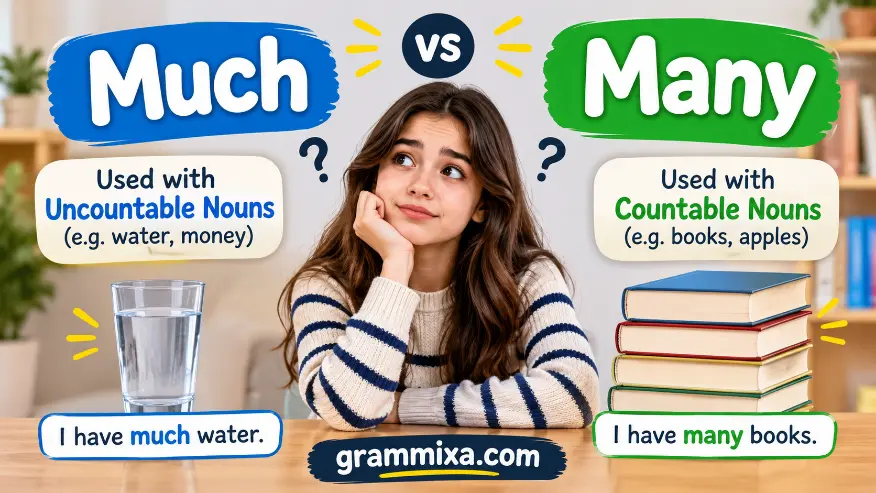
Understanding Much vs Many is essential for speaking and writing English correctly. Although both words are used to talk about quantities, they are not interchangeable. The main difference is simple: much is generally used with uncountable nouns, while many is used with countable nouns. Learning this basic rule can help you avoid common grammar mistakes and make your sentences sound more natural.
For example, you would say, “How much water do you drink?” because water is an uncountable noun. However, you would ask, “How many books do you have?” because books can be counted individually. Once you understand the difference between countable and uncountable nouns, choosing between much and many becomes considerably easier.
These words also appear frequently in questions, negative sentences, and everyday conversations. You might use them when talking about money, time, food, people, or everyday activities. Understanding when to use each word can improve your grammar, expand your vocabulary, and help you communicate more confidently.
In this guide, you will discover the meanings of much and many, learn the essential grammar rules, and explore clear examples of correct usage. You will also find common mistakes to avoid and practical tips to help you remember the difference. By the end, you will know when to use much, when to use many, and how to apply both words naturally in everyday English.
Much vs many depends on whether a noun is countable or uncountable. Use much with uncountable nouns, such as water, time, and money. Use many with countable plural nouns, such as books, people, and apples. For example, say “How much water?” but “How many bottles?” Both words help describe quantities.
Much vs Many: What Is the Difference?
The main difference between much and many is the type of noun they describe. Although both words refer to quantity, they follow different grammar rules.
- Much is used with uncountable nouns.
- Many is used with countable plural nouns.
Consider these examples:
| Much | Many |
|---|---|
| How much water do you drink? | How many glasses do you drink? |
| I don’t have much time. | I don’t have many appointments. |
| She doesn’t need much money. | She doesn’t need many coins. |
| We didn’t eat much rice. | We didn’t eat many sandwiches. |
The important distinction is what you are counting. Water, time, and rice are generally treated as uncountable nouns in these contexts. Glasses, appointments, coins, and sandwiches are countable nouns.
A useful way to remember the rule is to ask yourself whether you can count the noun as individual items in the sentence.
If you can count individual items, use many. If the noun refers to an uncountable amount or substance, use much.
What Does Much Mean?
Much means a large amount or quantity of something. It usually appears with uncountable nouns, which are nouns that we do not normally count as separate units.
Common uncountable nouns include:
- Water
- Milk
- Money
- Time
- Information
- Advice
- Furniture
- Traffic
- Homework
- Patience
For example:
- I don’t have much time today.
- There isn’t much milk left in the fridge.
- She gave me much useful information.
- We didn’t make much progress.
- How much homework do you have?
In everyday English, much is especially common in questions and negative sentences. In positive statements, speakers often prefer expressions such as a lot of or lots of.
For example:
- Natural: I have a lot of work today.
- Grammatical but more formal: I have much work today.
- Natural: I don’t have much work today.
This does not mean that much is incorrect in positive sentences. It can sound natural in expressions such as “Thank you very much,” “Much better,” and “Much has changed.”
The key is to understand both the noun and the sentence structure.
What Does Many Mean?
Many means a large number of people or things. It is used with countable plural nouns, which refer to items that can be counted individually.
Common countable nouns include:
- Books
- Friends
- Cars
- Students
- Questions
- Apples
- Tickets
- Problems
- Days
- Emails
For example:
- I have many books at home.
- How many students are in your class?
- She asked many questions.
- We visited many places during our trip.
- There aren’t many seats available.
Unlike much, many is natural in both positive and negative statements, as well as questions.
Compare these sentences:
- Positive: Many people enjoy reading.
- Negative: I don’t have many friends nearby.
- Question: How many pages are left?
In casual conversations, a lot of is also common with countable nouns.
For example, “I have many friends” and “I have a lot of friends” are both correct. The second may sound more conversational in everyday American English.
How to Identify Countable and Uncountable Nouns
Understanding countable and uncountable nouns is the easiest way to choose between much and many.
Countable Nouns
Countable nouns refer to things that can be counted individually. They usually have singular and plural forms.
Examples:
- One chair, two chairs
- One apple, five apples
- One student, twenty students
- One idea, three ideas
Use many when referring to a large number of these items.
Correct sentences:
- How many chairs do we need?
- There are many students in the library.
- I received many messages yesterday.
Uncountable Nouns
Uncountable nouns refer to substances, materials, abstract concepts, or categories that are not normally counted as individual units.
Examples:
- Water
- Sugar
- Air
- Knowledge
- Happiness
- Equipment
- Luggage
- Research
Use much when referring to the quantity of these nouns.
Correct sentences:
- How much sugar should I add?
- We don’t have much information.
- She has gained much knowledge from the course.
Some uncountable nouns can be counted when you refer to units or types. For instance, you cannot usually count water itself, but you can count bottles of water.
Compare:
- How much water do you need?
- How many bottles of water do you need?
The noun immediately following much or many helps determine which word is appropriate.
How to Use Much vs Many in Questions
Questions frequently use much and many to ask about quantities.
Use how much for uncountable nouns and how many for countable plural nouns.
| Question | Reason |
|---|---|
| How much money do you need? | Money is uncountable here. |
| How much time do we have? | Time is uncountable here. |
| How much coffee would you like? | Coffee refers to an amount. |
| How many people are coming? | People can be counted. |
| How many bags did you bring? | Bags are countable. |
| How many lessons are left? | Lessons are countable. |
Notice how changing the noun can change the question.
For example:
- How much coffee did you drink?
- How many cups of coffee did you drink?
The first question asks about the amount of coffee. The second asks about the number of cups.
You can apply the same rule when asking about food, shopping, travel, schoolwork, and everyday activities.
How to Use Much vs Many in Negative Sentences
Both words are common in negative sentences, especially when someone wants to say that the quantity is small or insufficient.
Use much with uncountable nouns:
- I don’t have much money.
- There isn’t much food left.
- He didn’t get much sleep.
- We don’t have much information about the event.
Use many with countable plural nouns:
- I don’t have many assignments.
- There aren’t many people here.
- She didn’t buy many vegetables.
- We haven’t received many replies.
In these examples, much and many describe a quantity that is limited or smaller than expected.
However, they do not always mean exactly the same thing as little or few. The words little and few can emphasize that the amount or number is insufficient.
For example:
- I don’t have much time.
- I have little time.
Both communicate a limited amount of time, but the second more strongly emphasizes the shortage.
Similarly:
- We don’t have many options.
- We have few options.
The second sentence places greater emphasis on the limited number of choices.
Much vs Many vs A Lot Of
One common source of confusion is knowing when to use much, many, or a lot of.
All three expressions can describe large quantities, but their grammatical patterns and typical usage differ.
| Expression | Used with | Example |
|---|---|---|
| Much | Uncountable nouns | I don’t have much time. |
| Many | Countable plural nouns | I have many books. |
| A lot of | Countable and uncountable nouns | I have a lot of work and a lot of books. |
| Lots of | Countable and uncountable nouns | She has lots of ideas and lots of patience. |
When Is A Lot Of Better?
In everyday conversation, a lot of is often more natural than much in positive statements.
For example:
- More conversational: I have a lot of homework.
- Less common in casual speech: I have much homework.
Both are grammatically possible, but the first is the more usual choice in ordinary conversation.
With countable nouns, both many and a lot of work naturally.
- Many people attended the meeting.
- A lot of people attended the meeting.
The first can sound more formal or emphasize the number. The second is common in everyday speech.
Is Lots Of Grammatically Correct?
Yes. Lots of is a common informal expression that works with both countable and uncountable nouns.
Examples:
- We have lots of time.
- She owns lots of books.
- There is lots of traffic today.
- They have lots of questions.
Remember that lots of is followed by a plural verb when its noun is plural, and by a singular verb when its noun is uncountable.
For example:
- Lots of students are waiting.
- Lots of water is available.
Common Mistakes When Using Much and Many
Even English learners who understand the basic rule can make mistakes when a noun seems countable in one situation but uncountable in another.
Here are common errors and their corrections.
| Incorrect | Correct | Explanation |
|---|---|---|
| How many water do you need? | How much water do you need? | Water is uncountable. |
| How much books do you have? | How many books do you have? | Books are countable. |
| I don’t have many money. | I don’t have much money. | Money is uncountable here. |
| There isn’t many people here. | There aren’t many people here. | People is plural and countable. |
| She gave me many advice. | She gave me much advice. | Advice is uncountable. |
| How many furniture do you need? | How much furniture do you need? | Furniture is uncountable. |
There is one more detail worth remembering: choosing much or many correctly does not automatically make the entire sentence correct. You must also use the right verb form.
For example, “There isn’t much water” is correct because water is uncountable and takes a singular verb in this construction.
However, “There aren’t many bottles” is correct because bottles is plural.
Nouns That Can Be Countable or Uncountable
Some English nouns can be countable in one context and uncountable in another. These are especially important because the correct choice depends on the meaning.
Coffee
When talking about the substance, coffee is generally uncountable.
– How much coffee is left?
When referring to individual servings, it can be countable.
– How many coffees did you order?
Here, coffees means cups or servings of coffee.
Chicken
When talking about meat, chicken is generally uncountable.
– How much chicken should I cook?
When referring to individual animals, it is countable.
– How many chickens does the farmer own?
Paper
When referring to the material, paper is uncountable.
– How much paper do we need?
When referring to individual documents, papers can be countable.
– How many papers did you submit?
Experience
When referring to knowledge gained over time, experience is uncountable.
– How much experience do you have?
When referring to separate events or occasions, experiences is countable.
– How many experiences changed your perspective?
These examples show why it is important to consider meaning rather than memorize a fixed list of nouns.
How Much vs How Many: Everyday Examples
The following examples show how the rule works in practical situations.
| Situation | Use much | Use many |
|---|---|---|
| Shopping | How much does this cost? | How many items are you buying? |
| School | How much homework do you have? | How many classes do you take? |
| Cooking | How much salt should I add? | How many eggs do I need? |
| Travel | How much luggage did you bring? | How many suitcases do you have? |
| Work | How much work remains? | How many tasks remain? |
| Social life | How much time can you spend? | How many friends are coming? |
Notice that the topic does not determine which word to use. The noun does.
For example, travel can involve much luggage or many suitcases. Both expressions are correct because luggage is uncountable, while suitcases are countable.
This is a useful principle for building confidence in everyday English.
FAQs:
1. Is it much people or many people?
The correct expression is many people because people is a countable plural noun.
For example: “How many people attended the event?”
2. Is money much or many?
Use much money because money is generally uncountable in English.
For example: “How much money do you need?”
You can use many when counting individual units of money, such as coins or banknotes.
3. Should I say how much time or how many times?
Both expressions are correct, but they mean different things.
- How much time asks about a duration or amount of time.
- How many times asks about the number of occasions something happens.
For example, “How much time do we have?” asks about the available duration, while “How many times have you visited?” asks about the number of visits.
4. Can much be used in positive sentences?
Yes. Much can appear in positive sentences, although a lot of is often more natural in everyday conversation.
For example, “Thank you very much” is a standard expression, and “Much has changed” is also correct.
5. Can I use many with uncountable nouns?
Generally, no. Use many with countable plural nouns and much with uncountable nouns.
For example, say “many books” and “much information.”
If an uncountable noun has a countable unit, you can use many with that unit, as in “many bottles of water.”
6. Is a lot of better than much or many?
Not always. A lot of is flexible and often sounds natural in positive statements and casual conversation. However, much and many are especially useful in questions and negative sentences.
For example, “I have a lot of work” sounds conversational, while “I don’t have much work” is a natural negative sentence.
Conclusion:
The difference between much vs many comes down to countable and uncountable nouns.
Use much for uncountable nouns such as water, money, time, and information. Use many for countable plural nouns such as books, people, questions, and cars.
When you are unsure, look at the noun rather than the topic of the sentence. If you are counting individual items, many is usually correct. If you are describing an amount that is not normally counted as separate items, much is usually the right choice.
Once you understand this simple distinction, you can use both words more confidently in writing, conversations, questions, and everyday English.`
