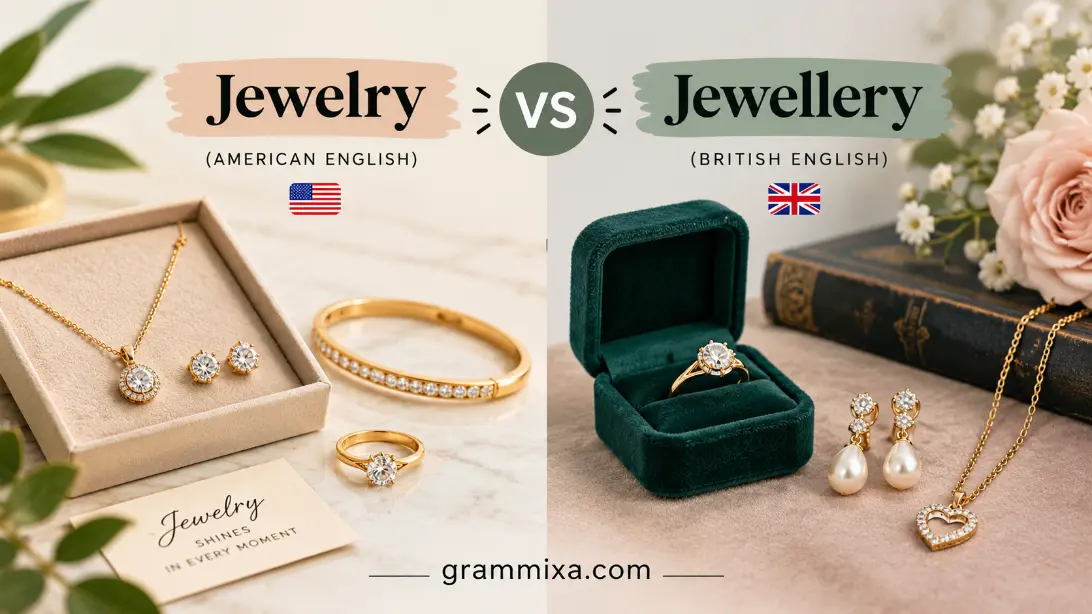
The difference between Jewelry vs Jewellery comes down to spelling, not meaning. Both words refer to decorative items such as rings, necklaces, bracelets, earrings, and other accessories made from materials like gold, silver, gemstones, and pearls. The main distinction is regional: jewelry is the standard spelling in American English, while jewellery is commonly used in British English, including the UK.
If you have ever wondered why the same word appears with one or two letters before the final y, you are not alone. This spelling difference often confuses writers, students, shoppers, bloggers, and businesses creating content for international audiences. The good news is that both spellings are correct, provided you use the version appropriate for your audience.
Understanding when to use jewelry or jewellery can help you write more naturally, improve consistency, and avoid unnecessary spelling mistakes. For example, an American online store will generally use terms such as “fine jewelry” and “jewelry collection,” whereas a British retailer will typically write “fine jewellery” and “jewellery collection.”
Jewelry and jewellery mean the same thing: decorative items worn on the body, such as rings, necklaces, bracelets, and earrings. Jewelry is the standard spelling in American English, while jewellery is commonly used in British English, including the UK. The difference is spelling, not meaning, value, or type of ornament.
Quick Answer: Jewelry vs Jewellery
The main difference between jewelry and jewellery is regional spelling. Both words refer to ornaments worn for personal decoration, including precious-metal pieces, gemstone accessories, and fashion jewelry.
| Word | Preferred usage | Example |
|---|---|---|
| Jewelry | American English | She bought a gold jewelry set. |
| Jewellery | British English | She bought a gold jewellery set. |
Both spellings are correct. The best choice depends on your audience, location, and writing style.
If you are writing for a US audience, use jewelry. If you are writing for a UK audience, use jewellery. For international content, choose one form based on your target readers and use it consistently.
What Does Jewelry or Jewellery Mean?
Jewelry or jewellery is a collective noun for decorative objects people wear on their bodies or clothing. These items can be made from precious metals, gemstones, glass, beads, wood, plastic, or other materials.
Common types include:
- Rings and wedding bands
- Necklaces and pendants
- Bracelets and bangles
- Earrings and ear cuffs
- Brooches and decorative pins
- Anklets and body jewelry
- Watches and decorative accessories
The term covers both expensive fine jewelry and affordable fashion accessories. An item does not need to contain diamonds, gold, or other precious materials to qualify as jewelry.
For instance, a silver necklace with a gemstone and a handmade bracelet made from colorful beads can both be described as jewelry or jewellery.
The meaning stays the same regardless of which spelling you use.
Is Jewelry Different From Jewellery?
No. Jewelry and jewellery are spelling variants of the same English word. Neither spelling refers to a separate category of accessories.
A jewelry store in the United States and a jewellery shop in the United Kingdom may sell the same types of products. The difference reflects local spelling conventions rather than the products themselves.
Jewelry vs Jewellery: The Main Spelling Rules
The difference comes down to how American and British English spell certain words. American English often uses shorter spellings in words where British English retains additional letters.
Here is how the two forms are used in everyday writing.
| American English | British English |
|---|---|
| Jewelry | Jewellery |
| Jeweler | Jeweller |
| Jeweled | Jewelled |
| Jewelry store | Jewellery shop |
| Fine jewelry | Fine jewellery |
| Jewelry box | Jewellery box |
These are common regional preferences, not absolute rules for every English-speaking country.
Why Does American English Use Jewelry?
American English generally favors the shorter spelling jewelry. The form is established in American dictionaries, retail businesses, product descriptions, and everyday writing.
For example:
- She collects vintage jewelry.
- The jewelry store offers custom rings.
- I keep my jewelry in a small wooden box.
- The designer launched a new fine jewelry collection.
If your readers are primarily in the United States, jewelry is the natural choice.
Why Does British English Use Jewellery?
British English generally favors jewellery, retaining the additional letters in the spelling.
Examples include:
- She wears handmade jewellery.
- The jewellery shop sells silver necklaces.
- He bought a jewellery box for his mother.
- The designer specializes in fine jewellery.
This spelling is standard in British publications, shops, and product descriptions.
Which Spelling Is Correct Internationally?
Neither spelling is universally required across all English-speaking countries. Usage varies by region.
British English commonly uses jewellery, while American English uses jewelry. Canadian English accepts both forms, although the double-l spelling is traditionally preferred in many Canadian writing contexts. Australian English generally follows the British spelling.
For international websites, consistency matters more than choosing one form as universally correct.
Jewelry vs Jewellery: Origin and History
Both spellings have historical roots in English words associated with jewels and decorative objects.
The word dates back to Middle English, with historical forms influenced by Old French juelerie. The term referred to precious ornaments or the work associated with jewels.
Over time, spelling conventions developed differently across English-speaking regions.
The shorter spelling, jewelry, became the standard American form. The longer spelling, jewellery, became established in British English.
The difference is part of a broader pattern of regional spelling variation. Other familiar examples include color and colour, favorite and favourite, and theater and theatre.
It is important not to assume that every American spelling is simply a newer version of a British word. English spelling differences developed through multiple historical and editorial influences.
How Did the Spelling Difference Become Common?
Regional spelling preferences became more established as dictionaries, publishers, schools, and newspapers developed their own conventions.
In the United States, dictionaries and style guides standardized jewelry as the usual spelling. In Britain, jewellery became the conventional form.
Modern digital communication has made both spellings easy to encounter worldwide. Online shops, international brands, social media posts, and search results regularly expose readers to both variants.
However, seeing both forms online does not mean they have different definitions.
Jewelry vs Jewellery: Pronunciation
Although the spelling differs, the pronunciation is broadly similar in American and British English.
The word is commonly pronounced with sounds resembling “joo-ul-ree,” although some speakers pronounce the middle vowel more distinctly.
Pronunciation can vary by accent, speaking speed, and individual preference.
| Variety | Common pronunciation pattern |
|---|---|
| American English | Often pronounced with three syllables or a compressed two-syllable form |
| British English | Often pronounced with three syllables |
The spelling does not determine a completely different pronunciation. Both forms refer to the same word, and speakers generally understand each other without difficulty.
For learners of English, the easiest approach is to learn the spelling preferred in the variety of English you use most often.
Jewelry vs Jewellery in Everyday Sentences
Seeing the words in context makes the difference easier to understand. The following sentences use both spellings naturally.
| American English | British English |
|---|---|
| I bought a new piece of jewelry. | I bought a new piece of jewellery. |
| Her jewelry collection is beautiful. | Her jewellery collection is beautiful. |
| Where is my jewelry box? | Where is my jewellery box? |
| The store sells handmade jewelry. | The shop sells handmade jewellery. |
| She designs gold jewelry. | She designs gold jewellery. |
| I need to clean my silver jewelry. | I need to clean my silver jewellery. |
Notice that the sentence structure and meaning remain unchanged. Only the spelling and, sometimes, other regional vocabulary choices differ.
Which Form Should You Use in a Business Email?
Use the spelling that matches your recipient or organization’s preferred style.
For an American customer, you might write:
“We are pleased to introduce our new fine jewelry collection.”
For a British customer, you might write:
“We are pleased to introduce our new fine jewellery collection.”
Both sentences are grammatically correct. Matching your audience’s spelling conventions helps your writing feel familiar and professional.
Which Form Should You Use on a Website?
Your target market should guide your choice.
- US online store: Use jewelry, jewelry care, and jewelry gifts.
- UK online store: Use jewellery, jewellery care, and jewellery gifts.
- International brand: Follow your main market’s spelling or maintain separate regional versions.
- General educational article: Explain both spellings and identify the regional preference.
For search engine optimization, use the spelling that reflects your audience’s language and search intent. You can mention the alternative spelling naturally when it helps readers, but avoid repeating both versions unnecessarily.
Jewelry vs Jewellery: Grammar and Word Forms
Both words follow the same basic grammatical patterns, but one detail often confuses English learners: jewelry and jewellery are generally uncountable nouns.
You normally refer to the category as jewelry or jewellery, rather than using the word as a regular plural noun.
Is Jewelry Singular or Plural?
Jewelry is generally treated as an uncountable noun in American English.
Jewellery is generally treated as an uncountable noun in British English.
Correct examples include:
- She owns a lot of jewelry.
- He gave her some beautiful jewellery.
- This jewelry is handmade.
- Her jewellery was carefully packed.
Avoid saying “many jewelries” when referring to multiple ornaments in ordinary English.
Instead, use a suitable counting expression.
| Less natural | Better wording |
|---|---|
| Three jewelries | Three pieces of jewelry |
| Many jewelries | Many pieces of jewellery |
| A jewellery | A piece of jewellery |
| Two jewelry | Two pieces of jewelry |
How Do You Talk About Multiple Items?
Use expressions such as:
- A piece of jewelry
- Two pieces of jewellery
- Several jewelry items
- A collection of jewelry
- Three pieces of fine jewellery
The word jewel is countable, but it usually refers to an individual precious stone or an object of special value. It is not always interchangeable with the collective term jewelry or jewellery.
What About Jewelry’s and Jewellery’s?
Both spellings can take an apostrophe to indicate possession.
Examples:
- The jewelry’s design is unusual.
- The jewellery’s craftsmanship is impressive.
These constructions are grammatically possible, although they may sound less natural than rewriting the sentence:
- The design of the jewelry is unusual.
- The craftsmanship of the jewellery is impressive.
Jewelry vs Jewellery: Common Mistakes
The spelling difference is simple, but a few common mistakes are worth avoiding.
Mixing Regional Spellings
Using jewelry in one paragraph and jewellery in another can make an article look inconsistent if the change is accidental.
Choose the form appropriate for your audience and apply it throughout the page.
The same principle applies to related words. If you use jewelry, jeweler, and jeweled in American English, keep those forms consistent. If you use jewellery, jeweller, and jewelled in British English, follow that convention.
Assuming Jewellery Means More Expensive Items
The additional letters do not indicate higher quality, a different material, or a luxury category.
A handmade bead necklace can be jewellery, just as a diamond necklace can be jewelry.
Price, craftsmanship, materials, and design determine the nature of an item, not the spelling of the word.
Thinking One Form Is Incorrect
Both forms are established English spellings.
Using jewellery in an American article may look unfamiliar to some readers, while jewelry may look unusual in a British publication. That does not automatically make either spelling grammatically wrong.
Confusing Jewelry With Jewels
The terms are related, but their meanings differ slightly.
Jewelry or jewellery refers collectively to decorative items worn on the body.
Jewels usually refers to precious stones or valuable ornamental objects, depending on context.
For example, “She inherited her grandmother’s jewelry” describes the collection as a whole. “The jewels were set in gold” may refer more specifically to precious stones.
Jewelry vs Jewellery: Similar Words and Alternatives
Several related words appear in conversations about accessories, fashion, and precious materials. Understanding their meanings can help you choose the right term.
| Word | Meaning |
|---|---|
| Jewel | A precious stone or a valuable decorative object |
| Jeweler | American spelling for a person who sells, repairs, or makes jewelry |
| Jeweller | British spelling of jeweler |
| Ornament | A decorative object, including items not worn on the body |
| Accessory | An item that complements clothing or personal style |
| Fine jewelry | Jewelry typically made with precious metals and often precious gemstones |
| Costume jewelry | Decorative jewelry generally made with less expensive materials |
| Bijou | A small, elegant jewel or piece of jewelry, particularly in literary or specialist usage |
These terms are related, but they are not perfect substitutes for one another.
For example, a handbag can be a fashion accessory, but it is not ordinarily described as jewelry. Similarly, an ornament may decorate a room rather than a person.
FAQs:
Is jewelry or jewellery correct?
Both are correct. Jewelry is the standard American English spelling, while jewellery is the usual British English spelling. The words have the same meaning and are pronounced similarly.
Why do Americans spell jewellery as jewelry?
American English uses the shorter spelling jewelry as its standard form. The difference developed through regional spelling conventions and became established in American dictionaries, publishing, and everyday usage.
Is jewellery British or American?
Jewellery is primarily associated with British English. It is also commonly used in other English-speaking regions, including Australia. American English generally prefers jewelry.
Is jewelry countable or uncountable?
Jewelry is generally an uncountable noun. You would usually say “a piece of jewelry” or “three pieces of jewelry” rather than “three jewelries.” The same rule applies to jewellery in British English.
Which spelling should I use for SEO?
Use jewelry when targeting an American audience and jewellery when targeting a British audience. Match your spelling to your readers, product market, and overall content style. Mention the alternative spelling naturally when it adds useful information.
Do jewelry and jewellery have different meanings?
No. Both words refer to decorative items such as rings, necklaces, earrings, and bracelets. The spelling difference does not indicate a difference in material, quality, price, or design.
Conclusion:
Jewelry and jewellery are two accepted spellings of the same word. The main distinction is regional: American English favors jewelry, while British English generally uses jewellery.
If you are writing for a US audience, choose jewelry. If you are writing for a UK audience, choose jewellery. For international readers, select the form that best matches your target market and use it consistently.
The simplest rule is to remember that the spelling changes, but the meaning stays the same.
