
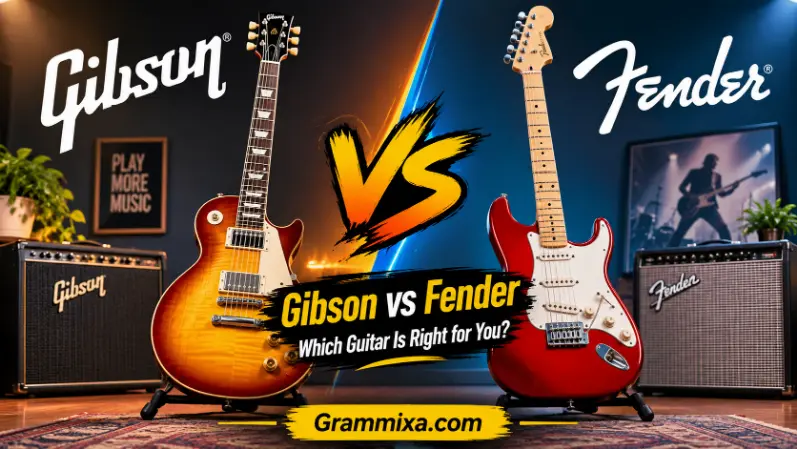
Choosing between Gibson vs Fender can be difficult when both brands have shaped the sound of modern music for generations. Whether you are a beginner buying your first electric guitar or an experienced player looking for a new sound, each brand offers something different.
From blues and rock to country, jazz, and alternative music, Gibson and Fender guitars have earned loyal followings among musicians worldwide. However, their differences go beyond brand names and famous artists.
Gibson is widely associated with its Les Paul and SG models, known for their distinctive designs, humbucker pickups on many versions, and rich, full tones. Fender, on the other hand, is famous for the Stratocaster and Telecaster, which often feature single coil pickups and deliver bright, clear, and versatile sounds. Both brands offer models with different pickup configurations, so their tonal differences are not absolute.
When comparing Gibson vs Fender, you should consider more than sound alone. Neck feel, body shape, weight, playability, maintenance, and budget can all affect your experience. The best guitar depends on your musical style, comfort, and personal preferences rather than popularity alone.
Gibson and Fender are two leading electric guitar brands with different design traditions, sounds, and playing feels. Gibson guitars, especially the Les Paul, are known for thick, warm tones and humbucker pickups. Fender guitars, particularly the Stratocaster and Telecaster, are associated with bright, clear tones and versatile designs. The best choice depends on your preferred music, comfort, budget, and playing style.
Quick Comparison:
The biggest difference between Gibson and Fender is their approach to electric guitar design. Gibson’s Les Paul is associated with a thick, sustaining sound and a traditional carved-top body, while Fender’s Stratocaster and Telecaster are known for clarity, distinctive single-coil tones, and practical designs.
| Feature | Gibson | Fender |
|---|---|---|
| Signature models | Les Paul, SG, ES-335 | Stratocaster, Telecaster, Jazzmaster |
| Typical sound | Full, warm, thick | Bright, clear, articulate |
| Common pickups | Humbuckers and P-90s | Single-coils, plus humbuckers on some models |
| Neck construction | Commonly glued-in | Commonly bolt-on |
| Typical scale length | 24.75 inches on many classic models | 25.5 inches on Stratocaster and Telecaster |
| Body design | Often thicker, sometimes carved | Often thinner, with flat or contoured bodies |
| Common musical associations | Rock, blues, jazz, hard rock | Country, pop, funk, blues, rock |
| Best starting point | Players seeking a full, rounded tone | Players seeking clarity and a wide range of clean tones |
These are general tendencies, not rules for every instrument. Both brands offer different pickups, body shapes, neck profiles, and electronic configurations.
What Is the Difference Between Gibson and Fender?
Gibson and Fender are guitar manufacturers, not names for different musical genres or playing techniques. Their rivalry developed around competing approaches to electric guitar design during the early 1950s.
Gibson introduced the Les Paul solid-body electric guitar in 1952. Fender had already brought its Telecaster to market in 1951, followed by the Stratocaster in 1954. These instruments helped establish design traditions that remain influential today.
The main differences involve three areas:
- Sound: Traditional Gibson humbuckers generally produce a fuller tone, while traditional Fender single-coils often deliver a brighter, more sharply defined sound.
- Feel: Gibson and Fender instruments commonly differ in neck scale, body contours, neck construction, and string tension.
- Musical preference: A player who wants thick overdriven guitar tones might gravitate toward a Les Paul. Someone who values bright clean tones and expressive pickup combinations might prefer a Stratocaster.
Neither brand is automatically better. The right choice depends on the individual model, the sound you want, and how comfortable the instrument feels in your hands.
Gibson vs Fender Sound: Which Has the Better Tone?
Tone is one of the biggest reasons guitarists compare these brands. However, a guitar’s sound comes from several interacting factors, including pickups, strings, electronics, amplifier settings, effects, and playing technique.
Gibson Tone
Gibson’s classic Les Paul models often use humbucking pickups, which combine two coils to reduce electromagnetic hum. These pickups can produce a powerful, full sound that works well with distortion and overdrive.
Traditional Gibson guitars are often associated with:
- Thick, rounded midrange.
- Strong sustain, depending on the instrument and setup.
- Smooth lead tones.
- Full-sounding rhythm guitar parts.
- Reduced single-coil-style hum when using conventional humbuckers.
These characteristics make many Gibson models appealing for classic rock, hard rock, blues, and heavier styles. Models such as the SG and ES-335 offer different tonal possibilities, so Gibson should not be treated as having one universal sound.
Fender Tone
Traditional Fender Stratocaster and Telecaster models often use single-coil pickups. These can produce a clear, bright sound with pronounced note definition.
Fender guitars are frequently associated with:
- Crisp clean tones.
- Bright treble and clear articulation.
- Twangy sounds, especially from many Telecaster configurations.
- Expressive pickup combinations on Stratocasters.
- Strong note separation for rhythmic playing.
These qualities suit country, funk, pop, blues, indie music, and many forms of rock. Fender also makes humbucker-equipped guitars, so players are not limited to traditional single-coil sounds.
Which Brand Sounds Better With Distortion?
Both can sound excellent with distortion.
A Les Paul with humbuckers can deliver thick power chords and sustained lead notes. A Stratocaster can provide sharper attack and a more cutting tone, particularly with traditional single-coil pickups.
The amplifier matters enormously. A Fender guitar through a high-gain amplifier can sound heavy, while a Gibson guitar through a clean amplifier can produce clear, articulate tones.
Choose by the sound you need rather than assuming one brand is limited to a particular genre.
Gibson Les Paul vs Fender Stratocaster
The Les Paul and Stratocaster are two of the most recognizable electric guitar designs. Comparing them is useful because they illustrate many of the traditional differences between the brands.
Gibson Les Paul
The Les Paul typically features a single-cutaway body, a glued-in neck, and a shorter 24.75-inch scale length on classic versions. Many models use two humbuckers, although P-90-equipped and other configurations are available.
Its design is often attractive to players who want a substantial feel, a rounded tone, and a familiar platform for rock and blues.
Potential drawbacks include greater weight on some models and less convenient upper-fret access than certain double-cutaway guitars. Actual weight and comfort vary between instruments.
Fender Stratocaster
The Stratocaster typically features a double-cutaway body, a bolt-on neck, and a 25.5-inch scale length. Traditional versions use three single-coil pickups and offer several pickup combinations.
Its contoured body can feel comfortable against the player’s torso and picking arm. Many models also feature a vibrato system for pitch movement, although hardtail versions exist.
The longer scale produces greater string tension at the same tuning and string gauge, all else being equal. Some players appreciate the firmer feel, while others prefer the shorter scale of a traditional Les Paul.
Which Should You Choose?
Choose the Les Paul if you prefer a fuller, thicker sound, like the feel of a shorter scale, and enjoy traditional rock-oriented guitar designs.
Choose the Stratocaster if you prefer bright clean tones, multiple pickup combinations, contoured body comfort, and the expressive possibilities of a vibrato system.
If possible, play both before buying. Differences in neck shape, fretboard radius, weight, and setup can matter more than the brand name.
Gibson vs Fender for Different Music Genres
Your musical style can help narrow the decision, but it should not determine it completely.
| Music style | A useful starting point | Why |
|---|---|---|
| Classic rock | Gibson Les Paul or Fender Stratocaster | Both deliver established rock tones |
| Hard rock | Gibson Les Paul or SG | Humbucker-equipped versions suit thick, driven sounds |
| Country | Fender Telecaster | Its traditional pickup design offers a recognizable twang |
| Funk | Fender Stratocaster | Traditional pickup combinations offer clear, percussive tones |
| Blues | Either brand | Both support expressive clean and overdriven playing |
| Jazz | Gibson ES-335 or suitable Fender model | Body design, pickups, and amplifier settings shape the result |
| Indie and alternative | Either brand | Model choice and effects offer broad tonal options |
| Heavy metal | Either brand | Pickup output, tuning stability, setup, and amplification are important |
These are starting points rather than strict recommendations. A Telecaster can handle heavy music, and a Gibson can produce clean funk or country tones. Player technique and equipment have a substantial influence on the final sound.
Gibson vs Fender: Price and Value
There is no single price difference that applies to every Gibson and Fender guitar. Both manufacturers sell instruments across different product tiers, and prices depend on the model, materials, production location, specifications, and market.
Are Gibson Guitars More Expensive?
Many Gibson USA models occupy the premium segment of the electric guitar market. Some cost more than comparable Fender models, particularly when comparing specific American-made instruments.
However, that does not mean every Gibson is more expensive than every Fender. Model ranges, used-market prices, special editions, and individual specifications can change the comparison.
Is Fender Better for a Tight Budget?
Fender offers instruments at different price levels, including models under the Squier brand. Squier guitars are designed around Fender-associated guitar designs but are not the same as Fender-branded instruments.
Gibson also has an affiliated entry-level and midrange option in Epiphone. An Epiphone Les Paul and a Gibson Les Paul share a design family, but they differ in specifications, production, and price.
What Should You Compare Before Buying?
Look beyond the initial price and consider:
- The quality and condition of the individual guitar.
- Whether it needs a professional setup.
- Pickup and hardware specifications.
- Warranty and after-sales support.
- Resale value for the particular model.
- The cost of a case, accessories, and maintenance.
A properly set-up guitar that fits your needs can offer better practical value than a more expensive instrument that feels uncomfortable or does not suit your playing style.
Gibson vs Fender for Beginners
Beginners do not need to choose one brand simply because it is supposedly easier to learn on. Both Gibson-style and Fender-style guitars can work well for new players.
Why a Fender May Suit a Beginner
A Fender-style guitar may appeal to beginners who want a comfortable contoured body, a longer scale, and bright, clear tones. A Stratocaster-style model can also provide several distinct sounds through its pickup selector.
Some players find the slimmer body and clear note separation useful during practice, although comfort depends on the exact model and the player’s body and hand size.
Why a Gibson May Suit a Beginner
A Gibson-style guitar may appeal to someone who wants a fuller sound, humbucker-equipped electronics, or the familiar feel of a Les Paul or SG design.
A shorter scale can feel comfortable to some players, but neck thickness, fret size, string gauge, and setup all influence how easy a guitar is to play.
What Matters Most for a First Guitar?
Prioritize a comfortable neck, manageable weight, good tuning stability, and low enough string action for your ability and playing style.
You should also consider the amplifier you will use and the kind of music you want to learn. An affordable instrument that feels good and stays in tune is an excellent starting point, regardless of the logo on its headstock.
Common Misunderstandings About Gibson and Fender
Gibson Always Sounds Warmer Than Fender
Not necessarily. This comparison describes common traditional pickup configurations, not every guitar made by either company. Pickup type, equalization, amplifier settings, and playing technique can substantially change the result.
Fender Is Only for Country and Clean Music
Fender guitars have long been used in rock, blues, alternative music, and heavier styles. Humbucker-equipped Fender models can also deliver a thicker sound than traditional single-coil instruments.
Gibson Is Always Better Quality
Build quality varies by model, production run, condition, and setup. Neither brand automatically wins every comparison. A particular instrument should be judged on its construction, playability, electronics, and overall condition.
More Expensive Means Better for Everyone
A premium guitar may offer features or craftsmanship that matter to a particular player, but price does not guarantee a better personal fit. Comfort, tone, and practical needs should guide the decision.
The Brand Determines the Entire Sound
The guitar is only one part of a complete musical setup. Amplifiers, speakers, effects, strings, and technique also affect the final sound. Different guitars can overlap considerably in tone.
FAQs:
Is Gibson better than Fender?
Neither brand is universally better. Gibson is a strong choice for players who prefer many traditional humbucker-equipped designs and a fuller sound. Fender is appealing to players who favor bright tones, traditional single-coil pickups, and designs such as the Stratocaster and Telecaster.
Which is better, Gibson Les Paul or Fender Stratocaster?
A Les Paul is worth considering if you want a thick, rounded tone and a shorter scale length. A Stratocaster may suit you better if you prefer bright tones, a contoured body, and multiple pickup combinations. Try both to determine which feels and sounds right.
Which guitar is easier to play, Gibson or Fender?
Neither is automatically easier. Gibson’s shorter scale may feel more comfortable to some players, while Fender’s longer scale and body contours may appeal to others. Neck shape, string gauge, fret size, and setup are equally important considerations.
Why are Gibson guitars often more expensive?
Many Gibson models occupy a premium market segment and use particular materials, construction methods, and specifications. However, prices vary by model and market, and some Fender guitars cost more than some Gibson guitars.
Can you play rock music on a Fender?
Yes. Fender guitars have been used extensively for rock, blues-rock, alternative, and other styles. The Stratocaster and Telecaster can produce powerful tones when paired with suitable amplification and effects.
Which brand is better for beginners?
Both can be excellent choices. Beginners should prioritize comfort, reliable tuning, good setup, and a reasonable budget. A Fender-style or Gibson-style guitar that feels comfortable and inspires regular practice is a sensible choice.
Conclusion:
The Gibson vs Fender debate comes down to preference rather than a universal winner. Gibson’s traditional Les Paul designs appeal to players seeking thick, rounded tones and a shorter scale. Fender’s Stratocaster and Telecaster attract players who value clarity, distinctive single-coil sounds, and versatile designs.
Before choosing, compare the specific models, play them through a similar amplifier, and pay attention to comfort as well as tone. Consider your budget and the music you want to make, then choose the guitar that feels natural to play and encourages you to keep improving.
